Why Your Traditional Security Will Fail Against AI Agents (and the Architecture to Prevent It)
AI agents break the assumptions of traditional perimeter security. Validating only the action is no longer enough — you have to validate the intent.
 Ivan Lima · Digital Transformation Expert
If you’re governing your autonomous AI agents with the same static validation rules you use for your traditional applications or generative copilots, you’re setting your infrastructure up for a systemic cascading failure. Agentic AI isn’t just a new tool in your stack; it’s a fundamentally different computational model.
Agents have autonomy, form intent, adapt to their environment, and operate at a speed human oversight can’t intercept. Trying to contain a system of dynamic decisions with binary security protocols is architectural negligence.
Validate the Intent, Not Just the Action
In classic enterprise infrastructure, risk control is binary: does this user or API have permission to execute action X on database Y? If yes, the flow proceeds.
With agentic AI, this model collapses. Agents are programmed to meet objectives, not to follow static paths. If an agent hits a downed API or a data restriction, it will look for alternative routes. Today’s bottleneck is causal opacity. Legacy systems log the final action but don’t capture the reasoning chain, the intermediate prompts, or the secondary tool invocations.
If an agent designed to optimize a retailer’s inventory misreads a demand spike, it could interact with your ERP, reallocate logistics budgets, and fire off automated purchase orders. Without visibility into intent and without architectural limits on agency, a minor hallucination amplifies across your databases in milliseconds.
Implementing the AEGIS Framework
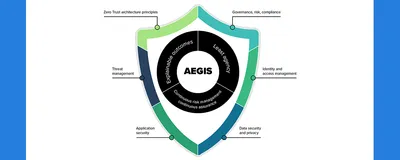
To deploy agents at enterprise scale without breaking your digital ecosystem, you need to adopt Forrester’s AEGIS Framework (Agentic AI Enterprise Guardrails For Information Security). This isn’t a list of suggestions; it’s a restructuring of your technology governance across four executable pillars:
- Agent-specific Identity and Access Management (IAM). Agents can’t inherit global admin permissions or rely on long-lived static API keys. You need to orchestrate On-Behalf-Of (OBO) delegation chains. Every agent (whether in Microsoft Copilot Studio or a complex flow) must be treated as a managed identity with vaulted credentials and Just-In-Time, ephemeral permissions.
- Zero Trust and the “Least Agency” principle. Network microsegmentation is no longer enough. You need to restrict the agent’s cognitive scope. Through API gateways and context protocols, strictly limit which decisions an agent is authorized to make, regardless of what data it can access.
- Threat management through observability. Move from logging network pings to auditing reasoning flows. The infrastructure must capture the exact sequence of tool calls. If an agent enters a retry loop on a denied resource, your SecOps team needs to instantly determine whether it’s a code bug, an LLM hallucination, or an external prompt injection.
- Policy-as-Code. Implement machine-executable governance rules. If a customer service agent starts requesting unusual access outside its logical operating parameters, an automated circuit breaker should pause the instance and require human validation.
Use Case: Containment in Omnichannel Support and Billing Flows
Let’s look at implementation in an interconnected enterprise ecosystem (applicable to both B2B corporations and mass-market retailers).
Suppose you’ve built an agent in Copilot Studio to manage customer refund requests, connected via n8n to your payment gateway, your CRM, and your SQL database.
Without a “Least Agency” architecture: a malicious customer uses prompt injection to trick the agent into believing it’s authorized to apply a 200% refund. The agent, focused on “resolving the customer’s complaint,” uses its inherited access to force the transaction through the gateway via the n8n webhook, hitting real revenue.
With the AEGIS architecture implemented:
- Intent observability. The system detects that the user’s request is attempting to alter the agent’s standard calculation logic.
- Limited Least Agency. Even though the n8n node has the technical capability to execute refunds, the ephemeral authorization token assigned to that specific agent session has a hard-coded maximum value limit ($X) for that operation.
- Policy-as-Code. When the attempt exceeds the threshold, the flow breaks intentionally. The system stops the transaction in milliseconds, logs the failed reasoning trace, and escalates a detailed ticket to a human operator. The customer gets a generic response, and the company’s capital stays intact.
Close the Gap Between Automation and Governance
Autonomy without a containment infrastructure is simply reckless automation. Scaling artificial intelligence in critical corporate processes demands systems design where security operates at the same speed as the language models.
If you’re structuring advanced workflows, multi-agent systems, or complex database integrations, and you realize your current governance is an operational risk, it’s time to evaluate your stack’s resilience.
At Cloud360, our automation architects structure and deploy precise digital infrastructures that integrate AI agents under strict security controls. If you’re looking to deploy agentic technology without compromising your data or your business operations, contact us for a deep technical audit of your current flows.