The New Copilot: What Changes for SMBs in Ecuador
Home, Code, and Autopilot turn Copilot into a collaborator that builds and executes. Why Ecuadorian SMBs gain the most, and how to keep spending under control.
 Carolina Iza · Business Development Manager at Cloud360
Microsoft just turned Copilot into a collaborator that builds applications and executes tasks without constant supervision. For a company that could never afford a development team, that changes the cost equation, but only if it governs spending from day one.
It’s Monday, 8:40 a.m., at a 45-person distributor in Guayaquil. The general manager asks for the overdue-accounts report broken down by salesperson. The one person in charge of systems is dealing with a printer, an email password, and closing out electronic invoicing. The report arrives Wednesday, built by hand in Excel.
That scene isn’t a talent problem. It’s a capacity problem. Ecuadorian SMBs have lived with the same limitation for years: they know what they need to automate, but they have no one to build it and no budget to hire someone who could.
On September 25, Microsoft introduced a Copilot that attacks exactly that limitation. If you lead IT at an SMB, this article explains what’s really changing, where the risk sits, and which decisions are worth making before the new features reach your users.
The numbers that explain why this matters here
| Figure | What it means |
|---|---|
| 54% of business jobs in 2025 came from micro, small, and medium enterprises | Any productivity gain in this segment shows up in the country’s economy |
| 92.2% of active companies are micro-businesses, and around 7.2% are small and medium | Most operate with minimal teams and no development area |
| USD 21 per user per month: Copilot Business pricing for organizations of up to 300 users | The base license is already accessible for an SMB |
| November 2: the CSP channel defaults new Copilot Business licenses to consumption-based billing, with a preset monthly cap | Most SMBs buy through a partner; variable spending arrives whether anyone asked for it or not |
What Microsoft announced, without the marketing pitch
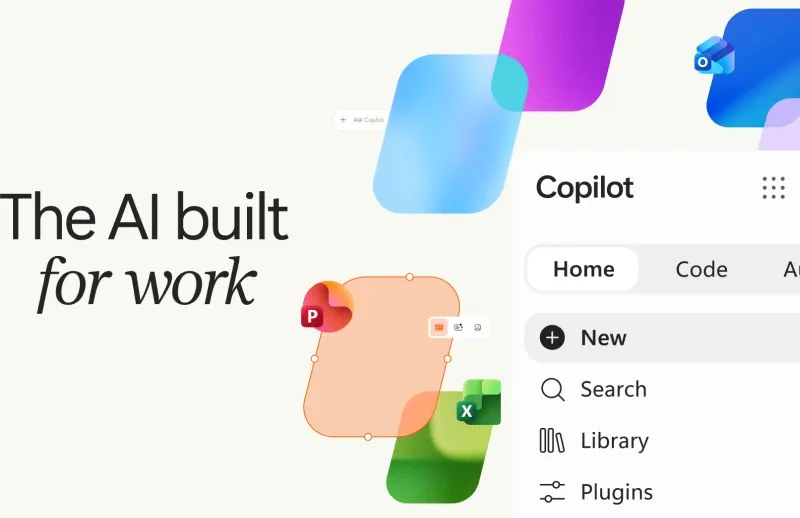
The announcement reorganizes the Copilot app into three capabilities. Each one solves something different.
Home: chatting and delegating in the same place
Home brings together Chat and Cowork: Chat handles day-to-day work, and Cowork lets you delegate complete tasks. Word, Excel, and PowerPoint are also integrated so you can create and edit documents right from Copilot itself.
- Chat for drafts and quick questions.
- Cowork for complete deliverables, start to finish.
Code: applications described in natural language
You describe an app, a tracker, a dashboard, an automation, or a workflow, and Copilot chooses the approach and builds it. It’s built on the same underlying technology as GitHub Copilot.
Autopilot: an agent that keeps working when you’re not
It’s given a name, a role, and a goal; it watches channels, follows up on conversations, executes recurring work, and picks projects back up days later.
Underneath all of it is Copilot Managed Runtime: infrastructure that runs the code securely inside the company’s Microsoft 365 environment, governed by IT.
The real change: who builds the company’s software
Generative AI isn’t new to anyone at this point. What’s new is where what the AI produces ends up.
Until now, an SMB that wanted an internal tool had three options: pay a vendor, stretch Excel past what’s reasonable, or put together something informal that nobody governed. The third option is the most common, and the most dangerous.
Code changes that because what gets built doesn’t stay on someone’s laptop. Access is controlled through Microsoft Entra identity, policies define which connectors and data each app can use, and version control with Git happens automatically. Every application shows up in the Microsoft 365 admin center with its access, usage, status, and policies in one place.
The SMB no longer has to choose between custom software and governed software. For the first time, it can have both.
For the IT department, the shift in role is clear: it stops being the bottleneck that builds everything and becomes the one that sets the rules everyone else builds under.
Autopilot: the collaborator the SMB could never hire
In its demo, Microsoft showed an Autopilot named Dot managing Black Friday inventory across 18 stores. Translate that to an Ecuadorian chain of hardware stores or pharmacies with ten locations: someone who checks for stockouts, chases down the supplier who never confirmed an order, and warns the manager before a product runs out.
A large company assigns a person to that task. An SMB can’t.
What matters for IT is how it works. Autopilot runs in the cloud, inside the tenant, with its own identity, memory, compute, and workspace, and you mention it in Teams or Outlook the way you would a colleague. That means it’s auditable and revocable like any other account.
An honest caveat: Autopilot expands its private preview on September 30, and Microsoft is targeting general availability by the end of the year. Today it’s a bet worth planning for, not something to put into production.
The risk isn’t the technology — it’s the bill
Here’s what the excitement usually leaves out. The per-user license covers “everyday” AI: Chat, Copilot inside the Office apps, and Office inside Copilot. Cowork, Code, Autopilot, and the more advanced models are billed by consumption through Copilot Credits, and that consumption requires the per-user license underneath it.
The problem is visibility. There are still no published rates for how many credits Code or Autopilot consume per task, or for hosting on Managed Runtime.
| Before | After |
|---|---|
| Fixed cost per license, easy to budget | Fixed cost plus a variable usage-based component |
| Main risk: licenses nobody uses | Main risk: consumption nobody watches |
| IT approves purchases | IT defines spending policies by group and user |
There are controls. Spending policies allow budgets per tenant and per group, per-user caps, threshold alerts, and a choice of what happens once the limit is reached. But there’s a catch: the option to automatically apply new services to those policies comes turned on by default, so a policy created for Cowork will absorb Code and Autopilot once they arrive.
At an SMB, AI doesn’t fail for lack of technical capacity. It fails when finance gets a bill nobody can explain.
How to prepare in the next 90 days
- Review how you buy your licenses. If you buy through a CSP partner, confirm with them what monthly cap consumption-based billing defaults to, and who approved it.
- Turn off automatic enrollment of new services. Enable each capability (Cowork, Code, Autopilot) by explicit decision, not by default.
- Decide your message to users. Starting in October, access to Cowork, Code, and Autopilot will be visible by default to every licensed user, even if they can’t use them yet. Decide whether they can request access and who approves it.
- Pick a small, measurable pilot. A group of five people, one concrete process (collections, inventory, sales reporting), and a metric for hours saved.
- Clean up your data before connecting agents. An agent with broad permissions over a disorganized SharePoint surfaces what nobody could find before. Review permissions and sensitivity labels first.
Reasonable objections
“This is all still in preview. Why move now?” You’re right not to put it into production. Frontier program features don’t carry a standard SLA, which rules out critical processes. But governing spending and data gets prepared beforehand, not after users have already found the button.
“We’re a 30-person company. This is for corporations.” It’s the opposite. A corporation already has developers, analysts, and operators. The SMB is the one gaining capacity it never had. The entry cost dropped too: a Copilot Business license runs around USD 21 per user, and you can assign it only to the roles where it’s justified.
“Isn’t this just the same thing as Power Apps?” Not exactly. Microsoft has stated that Code doesn’t replace Power Apps or Power Automate, since they start from different development models. If you’ve already invested in Power Platform, don’t abandon it — evaluate Code for the cases where describing the outcome is faster than designing it.
What’s at stake
For years, the gap between large companies and SMBs in Ecuador was about capacity: who could afford to pay people to build, automate, and monitor processes. The new Copilot doesn’t erase that gap, but it narrows it more than any tool before it.
The technology will reach your users within weeks, whether you decide it or not. What is up to you is whether it arrives with clear spending rules, organized data, and a measured business case.
The SMB that governs first will be the one that scales first.
Sources
- Microsoft — Introducing the new Copilot with Home, Code and Autopilot (Official Microsoft Blog, September 25, 2026)
- Microsoft Source EMEA — New Microsoft Copilot Brings Home, Code, and Autopilot Together
- Tom Arbuthnot, Empowering.Cloud — The New Copilot Explained: Home, Code and Autopilot, and what it means for Microsoft 365 admins
- The Windows Club — Microsoft introduces Copilot with Home, Code, and Autopilot
- El Oriente — Las mipymes concentran el 54% del empleo en las empresas de Ecuador (MEF data based on INEC’s REEM)
- El Nuevo Tiempo — Radiografía de las pymes en Ecuador: crecimiento, retos y oportunidades en 2026 (2024 REEM data, INEC)
- TrustedTech — Microsoft 365 Copilot Business – Everything You Need to Know