SecOps Architecture 2.0: How Microsoft Security Copilot Agents Redefine Autonomous Defense
The paradigm shift isn't about better dashboards — it's about changing the response architecture: moving from passive log collection to autonomous execution through specialized agents.
 Ivan Lima · Digital Transformation Expert
Corporate cybersecurity is losing the asymmetry war. While attackers run automated campaigns at scale using AI, Security Operations Centers (SOCs) still rely on manual human triage to review thousands of daily alerts. If your security infrastructure requires a human analyst to connect the dots between an identity log, an endpoint alert, and a data movement, your Mean Time to Respond (MTTR) is operationally unacceptable.
The paradigm shift isn’t about having “better dashboards” — it’s about changing the response architecture: moving from passive log collection to autonomous execution through specialized agents. This is exactly where Microsoft Security Copilot’s new agent architecture comes in.
The Operational Bottleneck: SOC Fragmentation
IT and RevOps leaders face an acute structural problem: tool fragmentation. Teams acquire best-of-breed solutions for data protection, device management, and identity. The result is a siloed data ecosystem.
When a complex incident occurs, the traditional flow fails by design:
- The SIEM fires an alert (often a false positive).
- A Tier 1 analyst has to pivot between 4 or 5 different consoles (Entra ID, Defender, Purview, Intune) to contextualize the threat.
- Manual correlation takes hours.
- By the time remediation is applied, exfiltration or lateral movement has already happened.
The human has become the execution bottleneck. Human intervention should be reserved for oversight and strategy, not for basic-level data collection and asset isolation.
A Network of Autonomous, Adaptive Agents
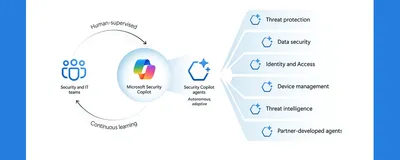
The evolution Microsoft Security Copilot introduces removes the human as the primary data processor and elevates them to system supervisor. Instead of being a simple AI chatbot, Copilot acts as a reasoning engine (LLM) that orchestrates a network of autonomous, adaptive agents.
Breaking down the security operating system’s infrastructure:
- Orchestrated reasoning engine. Security Copilot interprets the analyst’s intent or the context of a complex incident and determines which pieces of information and which actions are needed.
- Delegation to specialized agents. Instead of running a flat database query, Copilot deploys agents that interact directly with the company’s security domains. These agents are categorized by attack vector and management area:
- Threat protection: hunts for endpoint anomalies and correlates complex attack vectors.
- Data security: monitors flows of sensitive information, preventing exfiltration (DLP) and classifying compliance risks.
- Identity and Access: evaluates user risk in real time, capable of revoking session tokens or forcing conditional MFA when anomalies appear.
- Device management: interacts with the MDM (e.g., Intune) to verify a device’s compliance posture or isolate it from the corporate network.
- Threat intelligence: enriches incident context by cross-referencing IOCs (Indicators of Compromise) against global threat databases.
- Partner-developed agents: extends the architecture via plugins, allowing integration with perimeter firewalls, ITSM platforms (e.g., ServiceNow), or third-party network tools.
- Continuous learning loop. The system isn’t static. Decisions executed by the agents and corrections from the IT team feed back into the underlying models, adapting autonomous responses to your tenant’s specific traffic and usage patterns.
Autonomous Triage and Remediation of a Compromised Account
Suppose an adversary-in-the-middle (AiTM) attack scenario where an attacker compromises a corporate identity by evading traditional MFA.
Traditional operational flow (MTTR: 45–120 minutes): unusual sign-in detection → ticket creation → analyst reviews Entra ID → analyst checks Defender for file downloads → analyst manually revokes the session.
Flow with Security Copilot agents (MTTR: < 3 minutes):
- Initial detection. Copilot’s engine receives a high-risk signal from Entra ID.
- Parallel orchestration (autonomous phase). The Identity and Access agent traces the source IP, the anomalous session token, and prior sign-ins. The Data security agent instantly audits SharePoint and OneDrive logs associated with that user over the last 30 minutes, looking for mass downloads. The Device management agent verifies whether the access came from a managed, compliant device.
- Synthesis and human oversight. Security Copilot compiles a detailed narrative report with the exact attack chain. It presents an actionable prompt to the security team: “Session compromise detected with access to 3 confidential files. Do you want to isolate the device, revoke session tokens, and reset the password?”
- Execution. The analyst approves (human-supervised loop). Copilot instructs the agents to execute the remediation policies in milliseconds.
Take the Next Step in Your Operational Maturity
Adopting autonomous agents isn’t just about buying a license; it requires preparing your data infrastructure, cleaning up your identity policies, and correctly structuring your access controls so AI has safe ground to act on. Implementing AI on top of a broken architecture only automates the chaos.
If your SecOps team is still losing time on manual false-positive triage and you need to modernize your defense posture toward an autonomous model, it’s time to evaluate your infrastructure.
Request a technical SecOps architecture audit with Cloud360. We’ll map the current state of your infrastructure, identify the bottlenecks in your MTTR, and design a pragmatic deployment plan to integrate Microsoft Security Copilot agents into your real operational flows.