
An AI agent on the service desk: the ROI Forrester measured
Forrester measured a 321% three-year return when an AI agent resolves repetitive tickets on its own. What was measured, what was projected and what to take to your board.
 Ivan Lima · Digital Transformation Expert
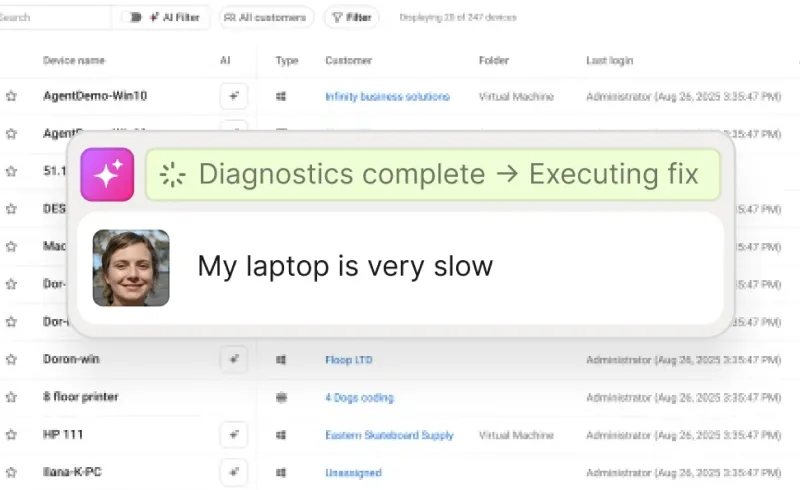
Your service desk doesn’t need more technicians. It needs fewer tickets.
A Forrester Consulting study commissioned by Atera measured what happens when an AI agent resolves repetitive tickets on its own: a 321% return over three years. The figure matters less than what it reveals about where your support budget is being lost today.
It’s 9:15 on a Monday. There are 40 tickets in the queue. Half are password resets, unresponsive printers and install requests. Your most experienced technician is working on one of them while the network segmentation project waits another week.
You know this scene. You probably also know the usual response: ask for another headcount, have finance turn it down and watch the team keep absorbing the volume at the expense of strategic work.
Forrester Consulting studied a concrete alternative: letting an autonomous AI agent, Atera’s Robin, resolve those tickets directly on the user’s device. It interviewed four companies already using it and modeled the outcome for a 2,500-employee organization. This article summarizes what it found, separates what was measured from what was projected and gives you arguments you can take to your board.
| Figure | What it means |
|---|---|
| 321% | Risk-adjusted return on investment over three years |
| Under 6 months | Time to pay back the investment |
| USD 5.6 million | Net present value for the composite organization |
| 90% | Manual tickets the agent resolved on its own in year 3 |
The most expensive ticket is the one never opened
The visible cost of support sits in the service desk: technician hours per ticket. The invisible cost sits in the rest of the company.
According to the study, the composite organization suffers about 11,000 IT annoyances a year that never become a ticket. Slow machines, apps that freeze, glitches users put up with because reporting them takes longer than living with them.
That lost time doesn’t show up in any IT metric. But the business pays for it.
There’s a second effect. When support is slow, some users fix things themselves: they install unauthorized tools and share files through unapproved channels. Forrester valued at USD 305,000 the shadow IT remediation the composite organization avoided by offering immediate support through official channels.
A slow service desk doesn’t just frustrate users: it pushes them outside the perimeter you control.
Routing isn’t resolving
Many tools sold as “AI for support” are, in practice, classifiers. They receive the ticket, tag it and send it to the right queue. Useful, but the technician still does the work.
The difference the study measures is something else: an agent that executes the fix on the user’s device and closes the ticket. The flow has four moments:
- Detect. It serves users 24/7 and watches for failures before they happen.
- Diagnose. It asks for what’s missing and runs the first tests.
- Resolve. It applies the fix and closes the ticket.
- Escalate with context. If it needs a technician, it hands over the diagnosis already done.
What matters is the curve. In the composite organization, the agent resolved 60% of manual tickets on its own in year 1, 75% in year 2 and 90% in year 3. Interviewees saw 60% within the first 90 days.
Autonomy isn’t a given: it grows with the knowledge base and with integrations into network, storage and applications.
85% of the value comes from two lines
When you present this case, don’t lean on the 321%. Lean on how the benefit breaks down, because that’s what you can verify with your own data.
| Benefit source (3 years, present value) | Amount |
|---|---|
| Avoided support costs | USD 3.3 million |
| Employee productivity | USD 2.9 million |
| Triage efficiency | USD 533,000 |
| Avoided shadow IT | USD 305,000 |
| Avoided hiring | USD 241,000 |
| Total benefits | USD 7.3 million |
| Total costs | USD 1.7 million |
Nearly 85% of the benefit comes from two sources: the support hours the agent takes on and the productive time employees get back.
That tells you exactly what to measure before deciding. If your volume of repetitive tickets is low or your users are already fairly self-sufficient, the case weakens. If not, the bulk of the argument is right there.
Your technicians aren’t redundant: they’re misallocated
In the composite organization, each technician handled 840 manual tickets a year. With the agent, that fell to 336 in year 1, 218 in year 2 and 91 in year 3.
The study documents other operational changes:
- Tickets that arrive complete. The agent asks for what’s missing and runs the initial diagnosis, saving about 30 minutes of triage per ticket.
- SLAs that are met. One interviewed organization went from 75% to 99% compliance on response times.
- Happier users. Satisfaction rose from 3.8 to 4.7 out of 5 in four months in one case.
- Prevention. A healthcare company set up temporary-file cleanup tasks before machines slowed down.
The data point that will help you most in the internal conversation is this: the companies in the study didn’t cut staff. They reassigned their technicians to cybersecurity, infrastructure and business projects.
The goal isn’t fewer technicians. It’s to stop paying senior talent to reset passwords.
What finance needs to hear
For a CFO, the appeal isn’t AI. It’s the cost structure.
- Predictable cost. The license Forrester modeled is USD 20 per user per month, with no upfront payment. It scales with headcount, not with incident volume. For the composite organization, that’s about USD 600,000 a year in licenses, plus implementation and internal upkeep.
- Fast payback. Cumulative undiscounted net benefit goes from USD 1.6 million in year 1 to USD 6.8 million in year 3. The investment pays back in under six months.
- Less reliance on hiring. The service desk is a high-turnover area. An agent that absorbs volume growth reduces exposure to vacancies, learning curves and night shifts. One interviewee absorbed twice the ticket volume in 12 months without hiring.
- Risk and compliance. Fewer unauthorized tools and fewer silent failures are audit arguments too, not just efficiency ones.
Autonomy is trained, not bought
The technical rollout is short: the study estimates two weeks to deploy across the composite organization, with about 80 hours of internal work. What defines the outcome comes afterwards.
The 90-day plan Atera proposes has four stages:
- Deployment (weeks 1–2). Rollout to every device, system integration and migration of historical tickets.
- Knowledge (weeks 3–6). Loading procedures and guides, starting with the most repeated tickets.
- Integrations (weeks 7–10). Connecting network, storage and critical applications.
- Measurement (weeks 11–13). Comparing autonomous resolution, SLAs and satisfaction against the baseline.
Before you start, do four things:
- Measure your starting point: tickets per month, mean time to resolution and SLA compliance.
- Identify your 10 most repeated ticket types.
- Assign someone to train the agent, about four hours a week.
- Agree with finance on how the return will be measured.
If you didn’t measure the before, you can’t defend the after.
Three objections worth taking seriously
“It’s a vendor-funded study.” True, and it’s worth saying out loud. Atera commissioned the study. Forrester states that it doesn’t endorse the product and recommends readers use their own estimates. In the methodology’s favor: the analysis adjusts every benefit down and every cost up, and applies a 10% discount rate. Also, some figures in Atera’s material, such as hours recovered per technician and projections for MSPs, are the vendor’s own calculations, not Forrester’s findings. Treat the study as a well-built hypothesis, not a promise.
“My reality doesn’t look like the composite organization.” Probably not. The model assumes 2,500 employees, 30 technicians, USD 800 million in revenue and benchmark labor costs that may be higher than in your country. In Latin America, where a technician’s hourly cost is usually lower, the “avoided support costs” line may shrink while the per-user license stays the same. Run the numbers with your salaries and your real volume. If the case only holds up on someone else’s assumptions, it doesn’t hold up.
“I don’t want an autonomous agent making changes on our devices.” That’s a legitimate concern. An agent that resolves has more permissions than one that classifies. Before deploying, define which kinds of action it can take without approval, what gets logged and how it’s audited. Start with low-risk cases and widen the scope as the evidence justifies it.
Tier 1 is no longer a staffing problem
For years, the answer to ticket volume was to hire. That answer made sense when there was no other. Today there is evidence, with its caveats, that a large share of repetitive work can leave the human queue without degrading service, and in some cases while improving it.
The decision isn’t whether to automate support. It’s how much longer your team can spend its best hours on tasks that no longer need a person.
Every repetitive ticket a technician handles is a strategic project put off.
Your first step this week: pull the 10 most frequent request types from your ticketing tool and the time your team spends on them each month. With that figure and your real hourly cost, you’ll have, in one afternoon, the basis to know whether this case applies to your organization, before talking to any vendor.
Sources
- Forrester Consulting — The Total Economic Impact™ Of Robin By Atera, study commissioned by Atera, August 2026.
- Atera — Robin by Atera: the business case in numbers (ebook based on the Forrester study), 2026.